
Skip to content
  • Contact Us
Corporate Class Inc Logo
  • COACHING
  • WORKSHOPS
    • Executive Presence and Leadership Skills
    • Diversity & Inclusion
    • Women in Leadership Masterclass: Power Up Your Presence
    • Empowered Mindset for Leaders
    • The Five Behaviors of a Cohesive Team
    • Board Presence for Senior Management
    • Presentation Skills
    • Personal Branding
    • Discover Your Unique Value Proposition
    • Mental Fitness by Positive Intelligence
    • Corporate Well-Being Training for Leaders and Teams
    • Lunch & Learns
  • CERTIFICATIONS
    • ICF Certified Executive Presence and Leadership Skills
    • Personality Assessment – Master Level Certification Prerequisite
    • Personality Assessment – Master Level Certification
  • ASSESSMENTS
    • Personality & Behavior Assessment
    • Fascination Advantage® Assessment
    • Presentation Skills Analysis: FIGARO
    • EQ-i 2.0 Assessment
    • Korn Ferry Leadership Architect Tool™
    • EQ 360 Assessment
    • DiSC Assessment
    • Hogan Assessments
  • DIVERSITY & INCLUSION
  • RESOURCES
    • Blog
    • Books
    • Podcasts
    • Presentation Skills Quiz
    • Closing the Virtual Teamwork Skills Gap
    • The 7 Business Benefits Whitepaper
    • Cost of Hiring and Developing People
    • Videos
    • Join Our Mailing List
    • FAQ
  • ABOUT US
    • Our Approach
    • Our Company
    • Our Team
    • Our Clients
    • Testimonials
    • In the News
  • COACHING
  • WORKSHOPS
    • Executive Presence and Leadership Skills
    • Diversity & Inclusion
    • Women in Leadership Masterclass: Power Up Your Presence
    • Empowered Mindset for Leaders
    • The Five Behaviors of a Cohesive Team
    • Board Presence for Senior Management
    • Presentation Skills
    • Personal Branding
    • Discover Your Unique Value Proposition
    • Mental Fitness by Positive Intelligence
    • Corporate Well-Being Training for Leaders and Teams
    • Lunch & Learns
  • CERTIFICATIONS
    • ICF Certified Executive Presence and Leadership Skills
    • Personality Assessment – Master Level Certification Prerequisite
    • Personality Assessment – Master Level Certification
  • ASSESSMENTS
    • Personality & Behavior Assessment
    • Fascination Advantage® Assessment
    • Presentation Skills Analysis: FIGARO
    • EQ-i 2.0 Assessment
    • Korn Ferry Leadership Architect Tool™
    • EQ 360 Assessment
    • DiSC Assessment
    • Hogan Assessments
  • DIVERSITY & INCLUSION
  • RESOURCES
    • Blog
    • Books
    • Podcasts
    • Presentation Skills Quiz
    • Closing the Virtual Teamwork Skills Gap
    • The 7 Business Benefits Whitepaper
    • Cost of Hiring and Developing People
    • Videos
    • Join Our Mailing List
    • FAQ
  • ABOUT US
    • Our Approach
    • Our Company
    • Our Team
    • Our Clients
    • Testimonials
    • In the News
Corporate Class Inc Logo
  • WORKSHOPS
    • Certificate Programs
      • ICF Certified Executive Presence and Leadership Skills
      • Breakthrough Point Certification Program
    • Open Enrollment Workshops
      • Executive Presence and Leadership Skills
      • Dare to Lead
      • Women in Leadership Masterclass
      • Master Level Certification for Trainers and Coaches
      • Powerful Executive Presence: A C-Suite Readiness Program
      • DEI Half-Day Workshop
      • Mental Fitness by Positive Intelligence
      • Social Selling Bootcamp – Build Your Brand
    • Workshops For Teams
      • Executive Presence and Leadership Skills
      • Dare to Lead
      • Diversity & Inclusion
      • Women in Leadership Masterclass: Power Up Your Presence
      • Empowered Mindset for Leaders
      • The Five Behaviors of a Cohesive Team
      • Board Presence for Senior Management
      • Presentation Skills
      • Personal Branding
      • Discover Your Unique Value Proposition
      • Mental Fitness by Positive Intelligence
      • Corporate Well-Being Training for Leaders and Teams
    • Lunch & Learns
  • COACHING
    • Private & Group Coaching
    • Consulting
  • ASSESSMENTS
    • Fascination Advantage® Assessment
    • Presentation Skills Analysis: FIGARO
    • EQ-i 2.0 Assessment
    • Korn Ferry Leadership Architect Tool™
    • EQ 360 Assessment
    • DiSC Assessment
    • Hogan Assessments
    • The Breakthrough Point Assessment Subscription
  • DIVERSITY & INCLUSION
  • RESOURCES
    • Blog
    • Books
    • Podcasts
    • Presentation Skills Quiz
    • Closing the Virtual Teamwork Skills Gap
    • The 7 Business Benefits Whitepaper
    • Cost of Hiring and Developing People
    • Videos
    • Join Our Mailing List
    • FAQ
  • ABOUT US
    • Our Approach
    • Our Company
    • Our Team
    • Our Clients
    • Testimonials
    • In the News
  • WORKSHOPS
    • Certificate Programs
      • ICF Certified Executive Presence and Leadership Skills
      • Breakthrough Point Certification Program
    • Open Enrollment Workshops
      • Executive Presence and Leadership Skills
      • Dare to Lead
      • Women in Leadership Masterclass
      • Master Level Certification for Trainers and Coaches
      • Powerful Executive Presence: A C-Suite Readiness Program
      • DEI Half-Day Workshop
      • Mental Fitness by Positive Intelligence
      • Social Selling Bootcamp – Build Your Brand
    • Workshops For Teams
      • Executive Presence and Leadership Skills
      • Dare to Lead
      • Diversity & Inclusion
      • Women in Leadership Masterclass: Power Up Your Presence
      • Empowered Mindset for Leaders
      • The Five Behaviors of a Cohesive Team
      • Board Presence for Senior Management
      • Presentation Skills
      • Personal Branding
      • Discover Your Unique Value Proposition
      • Mental Fitness by Positive Intelligence
      • Corporate Well-Being Training for Leaders and Teams
    • Lunch & Learns
  • COACHING
    • Private & Group Coaching
    • Consulting
  • ASSESSMENTS
    • Fascination Advantage® Assessment
    • Presentation Skills Analysis: FIGARO
    • EQ-i 2.0 Assessment
    • Korn Ferry Leadership Architect Tool™
    • EQ 360 Assessment
    • DiSC Assessment
    • Hogan Assessments
    • The Breakthrough Point Assessment Subscription
  • DIVERSITY & INCLUSION
  • RESOURCES
    • Blog
    • Books
    • Podcasts
    • Presentation Skills Quiz
    • Closing the Virtual Teamwork Skills Gap
    • The 7 Business Benefits Whitepaper
    • Cost of Hiring and Developing People
    • Videos
    • Join Our Mailing List
    • FAQ
  • ABOUT US
    • Our Approach
    • Our Company
    • Our Team
    • Our Clients
    • Testimonials
    • In the News
work with us
Corporate Class Inc Logo
  • WORKSHOPS
    • Certificate Programs
      • ICF Certified Executive Presence and Leadership Skills
      • Breakthrough Point Certification Program
    • Open Enrollment Workshops
      • Executive Presence and Leadership Skills
      • Dare to Lead
      • Women in Leadership Masterclass
      • Master Level Certification for Trainers and Coaches
      • Powerful Executive Presence: A C-Suite Readiness Program
      • DEI Half-Day Workshop
      • Mental Fitness by Positive Intelligence
      • Social Selling Bootcamp – Build Your Brand
    • Workshops For Teams
      • Executive Presence and Leadership Skills
      • Dare to Lead
      • Diversity & Inclusion
      • Women in Leadership Masterclass: Power Up Your Presence
      • Empowered Mindset for Leaders
      • The Five Behaviors of a Cohesive Team
      • Board Presence for Senior Management
      • Presentation Skills
      • Personal Branding
      • Discover Your Unique Value Proposition
      • Mental Fitness by Positive Intelligence
      • Corporate Well-Being Training for Leaders and Teams
    • Lunch & Learns
  • COACHING
    • Private & Group Coaching
    • Consulting
  • ASSESSMENTS
    • Fascination Advantage® Assessment
    • Presentation Skills Analysis: FIGARO
    • EQ-i 2.0 Assessment
    • Korn Ferry Leadership Architect Tool™
    • EQ 360 Assessment
    • DiSC Assessment
    • Hogan Assessments
    • The Breakthrough Point Assessment Subscription
  • DIVERSITY & INCLUSION
  • RESOURCES
    • Blog
    • Books
    • Podcasts
    • Presentation Skills Quiz
    • Closing the Virtual Teamwork Skills Gap
    • The 7 Business Benefits Whitepaper
    • Cost of Hiring and Developing People
    • Videos
    • Join Our Mailing List
    • FAQ
  • ABOUT US
    • Our Approach
    • Our Company
    • Our Team
    • Our Clients
    • Testimonials
    • In the News
  • WORKSHOPS
    • Certificate Programs
      • ICF Certified Executive Presence and Leadership Skills
      • Breakthrough Point Certification Program
    • Open Enrollment Workshops
      • Executive Presence and Leadership Skills
      • Dare to Lead
      • Women in Leadership Masterclass
      • Master Level Certification for Trainers and Coaches
      • Powerful Executive Presence: A C-Suite Readiness Program
      • DEI Half-Day Workshop
      • Mental Fitness by Positive Intelligence
      • Social Selling Bootcamp – Build Your Brand
    • Workshops For Teams
      • Executive Presence and Leadership Skills
      • Dare to Lead
      • Diversity & Inclusion
      • Women in Leadership Masterclass: Power Up Your Presence
      • Empowered Mindset for Leaders
      • The Five Behaviors of a Cohesive Team
      • Board Presence for Senior Management
      • Presentation Skills
      • Personal Branding
      • Discover Your Unique Value Proposition
      • Mental Fitness by Positive Intelligence
      • Corporate Well-Being Training for Leaders and Teams
    • Lunch & Learns
  • COACHING
    • Private & Group Coaching
    • Consulting
  • ASSESSMENTS
    • Fascination Advantage® Assessment
    • Presentation Skills Analysis: FIGARO
    • EQ-i 2.0 Assessment
    • Korn Ferry Leadership Architect Tool™
    • EQ 360 Assessment
    • DiSC Assessment
    • Hogan Assessments
    • The Breakthrough Point Assessment Subscription
  • DIVERSITY & INCLUSION
  • RESOURCES
    • Blog
    • Books
    • Podcasts
    • Presentation Skills Quiz
    • Closing the Virtual Teamwork Skills Gap
    • The 7 Business Benefits Whitepaper
    • Cost of Hiring and Developing People
    • Videos
    • Join Our Mailing List
    • FAQ
  • ABOUT US
    • Our Approach
    • Our Company
    • Our Team
    • Our Clients
    • Testimonials
    • In the News
work with us
  • 416-967-1221
  • Visit the Centre for Diversity and Inclusion
  • BLOG
  • PODCAST
  • FAQS
  • CONTACT US

Author: Terri Williams

Terri L. Williams, is a certified Dare to Lead Facilitator. She is a US Army Veteran and survivor of the September 11th Attack on the Pentagon.

  1. Home
  2. Terri Williams

Gender and Leadership: The Role Gender Plays

Gender and Leadership

Gender should not play a role in leadership because the most critical factor in effective leadership is a person’s ability to inspire, motivate, and guide a team toward a common goal. These skills and qualities are not limited to one gender, and anyone has the potential to be a strong and effective leader. It is essential to focus on an individual’s skills, experience, and suitability for the role rather than their gender.

In this blog post, we’ll cover why women are often overlooked as leaders in the workplace and the importance of female leaders. 

Women Are Under-Recognized in the Workplace

There are many reasons why women are considered underrecognized in the workplace. One reason is the gender pay gap, which refers to the difference in pay between men and women performing the same job. This pay gap exists in many countries worldwide and can be caused by various factors, including discrimination and biases against women. Another reason is the need for more representation of women in leadership positions. Despite making up half of the workforce, women are still underrepresented in top leadership roles, making it harder for them to be recognized for their contributions.

Additionally, unconscious biases can play a role in the underrecognition of women in the workplace. These biases can lead to women being overlooked for promotions or not being given the same opportunities as their male counterparts. It’s important to recognize and address these issues to create a more inclusive and equitable workplace.

Gender and Characteristics for Leadership

Leadership is a trait that is not limited to a specific gender. Both men and women can exhibit strong leadership qualities and be successful leaders. However, research has shown that particular leadership characteristics are more commonly associated with one gender over another when both genders have the capacity to exhibit these traits. For example, men are often seen as more decisive and confident, while women are viewed as more collaborative and empathetic. It is essential to recognize that these characteristics are not exclusive to one gender and that anyone can possess and cultivate these traits to become an effective leader. It is also important to strive for diversity and inclusivity in leadership, as having a range of perspectives and experiences can lead to better collaboration, more decisive and innovative decision-making, and better outcomes.

Does Gender Matter When It Comes to Leadership? 

When it comes to leadership, the most crucial factor is a person’s ability to inspire, motivate, and guide a team toward a common goal. The most influential leaders are those who can adapt their style and approach to suit the needs of their team and the situation at hand. Gender should not be a determining factor in one’s ability to lead, as any person, regardless of their gender, has the potential to be a strong and effective leader. It is essential for organizations to focus on an individual’s skills, experience, and suitability for the role rather than their gender.

Why Having Women in Leadership Is Important

Having women in leadership positions is vital for several reasons. First, diversity in leadership leads to better decision-making and problem-solving, as a range of perspectives and experiences are brought to the table. This can lead to more innovative and effective solutions. Additionally, having women in leadership positions is an inspiration for other women, breaking down barriers and negative stereotypes that may prevent women from pursuing leadership roles. As a result, It is essential for organizations to strive for gender parity in leadership to ensure that all voices and perspectives are heard and represented. 

Want to create a more inclusive and diverse workplace?

Invest in team workshops!

Corporate Class offers diversity and inclusion training workshops where our expert facilitators work with your organization to deliver high-impact content tailored to your business. 

Additionally, Corporate Class offers a 2-day, customizable executive presence workshop for women. Here, participants will learn how to own their voice, project confidence, rise above barriers, and much more. 

Contact the experts at Corporate Class to learn more about our workshops that will help you break down barriers and biases around gender and leadership!
female leaders leadership positions negative stereotypes representation of women

How to assess your own interpersonal communication skills

To assess your interpersonal communication skills, start by evaluating how clearly you express your thoughts, how well you listen, and how effectively you respond in conversations. Strong communication isn’t just about talking, it includes reading non-verbal cues, managing your tone, and making sure your message is understood. This guide will walk you through practical ways to identify strengths and improve weak spots, so you can build better connections in both personal and professional settings.

Key Takeaways

  • Understanding how you express yourself, and how others perceive you, is the first step to becoming a better communicator.
  • Practicing active listening, managing emotions, and observing skilled communicators can help you build stronger, more authentic connections.
  • Clear, confident communication helps you build trust, navigate challenges, and stand out as a leader in any professional environment.

What Are Interpersonal Communication Skills?

Interpersonal communication refers to how you engage with people through both spoken language and non-verbal behaviour. These skills shape how effectively you collaborate in teams, connect with clients, lead initiatives, manage conflicts, and build long-term professional relationships.

Improving your ability to communicate with clarity, empathy, and confidence can lead to significant growth in how you express ideas, listen actively, and respond thoughtfully. By assessing how you interact in various settings, you create the opportunity to strengthen both your personal connections and career trajectory.

Self-Assessment: How Strong Are Your Interpersonal Communication Skills?

Assessing your communication skills isn’t just about identifying flaws; it’s about becoming more self-aware, empathetic, and intentional in your daily interactions. Begin with a reflective mindset and answer these questions honestly. Consider writing down your thoughts or journaling about specific conversations you’ve had recently.

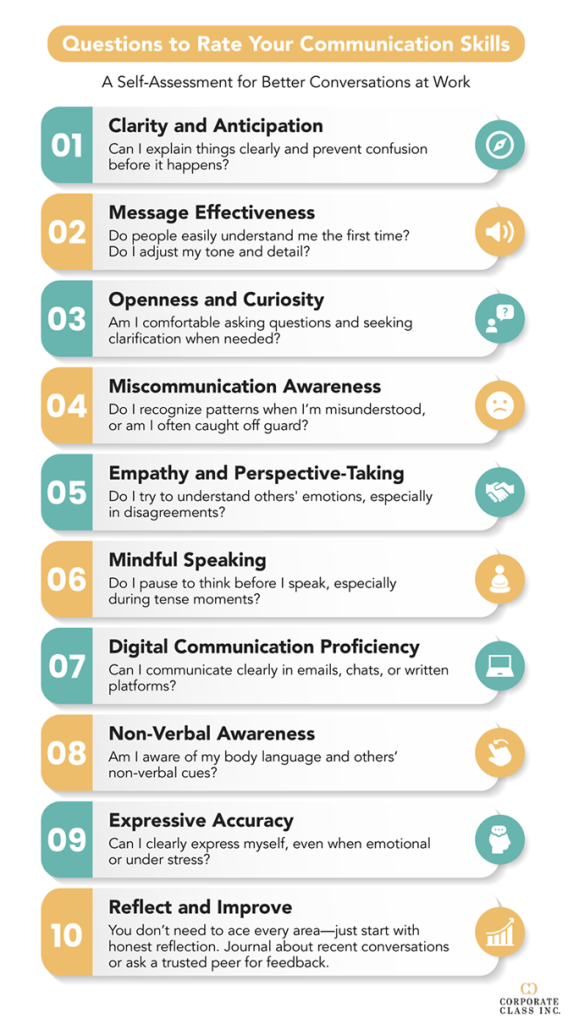
Infographic titled 'Questions to Rate Your Communication Skills,' providing a 10-point self-assessment for improving workplace conversations, covering aspects like clarity, message effectiveness, empathy, and digital communication.

Here are key questions to guide your assessment:

Clarity and Anticipation

Can I anticipate confusion or miscommunication before it happens? Do I provide enough context when explaining ideas or giving instructions? These questions help you evaluate how proactive and thoughtful you are when sharing information.

Message Effectiveness

Do people regularly understand my messages the first time? Do I adjust my level of detail or tone based on the audience? Reflecting on this highlights your ability to tailor your communication to meet others’ needs.

Openness and Curiosity

Do I feel comfortable asking questions when I don’t understand something? How often do I seek clarification versus pretending to understand? This checks your willingness to stay engaged and clarifies for mutual understanding.

Miscommunication Awareness

Do I notice patterns in how people misinterpret me? Am I often surprised by misunderstandings? These questions help you recognize recurring gaps between what you say and what others perceive.

Empathy and Perspective-Taking

Can I put myself in someone else’s shoes during conversations, especially during disagreements? This reveals how well you acknowledge and consider the emotions and viewpoints of others.

Mindful Speaking

Do I pause and think about how my words will be received, or do I tend to speak reactively? Your answer uncovers how much thought you put into the timing, tone, and impact of your words.

Digital Communication Proficiency

How effective am I at communicating clearly through text-based platforms like email, chat, or project management tools? This helps you assess how well you express ideas and expectations in writing.

Non-Verbal Awareness

Am I aware of my own body language, and can I read subtle cues in others, such as tone shifts or facial expressions? This checks your skill in interpreting and controlling unspoken signals that influence conversations.

Expressive Accuracy

Do I struggle to articulate my ideas clearly, especially when I’m emotional or under pressure? This helps identify emotional states that interfere with your ability to communicate precisely.

If you struggle to answer some of these questions or find gaps in your abilities, that’s perfectly normal. Even highly skilled communicators have blind spots. The goal isn’t perfection, it’s progress. Regularly assessing yourself helps you identify recurring communication challenges and become more intentional in how you express and interpret messages.

For deeper insight, consider asking for feedback from coworkers, mentors, or close friends. They can often highlight strengths and areas for improvement that you may not notice yourself.

Why Interpersonal Communication Skills Matter in Your Career

Interpersonal communication is one of the most in-demand skill sets in today’s professional environment. How you interact with colleagues, clients, and supervisors can influence your career growth just as much as technical expertise. People with strong communication skills are more likely to be seen as leaders, collaborators, and problem-solvers, qualities that organizations actively seek and reward.

Improving your communication skills can directly impact your ability to:

  • Advance in your career by articulating your value and building influence
  • Build stronger workplace relationships built on trust, clarity, and respect
  • Win over clients and customers through clear, persuasive messaging
  • Negotiate more effectively by understanding both sides and presenting compelling arguments
  • Resolve conflicts with confidence and empathy, leading to better team morale and outcomes

The modern workplace values emotional intelligence, adaptability, and the ability to work well across diverse teams. Being a strong communicator enhances your credibility and makes you more adaptable to various roles and responsibilities. It is a skill set that grows your potential and sets you apart in any industry.

3 Key Interpersonal Skills to Develop

Mastering interpersonal communication involves a mix of intentional practice, emotional intelligence, and self-awareness. These core skills form the foundation of every meaningful conversation, even if you’re presenting in a boardroom, mentoring a team member, or resolving a disagreement. Developing them not only boosts your confidence but also enables you to navigate complex social dynamics with clarity and empathy.

Focusing on these core areas can help you grow into a more effective communicator:

1. Verbal Communication

This involves more than just talking. It’s about choosing the right tone, vocabulary, and level of detail for your audience and situation.

Example: You’d use a different language when presenting a marketing pitch to executives versus explaining a process to a new hire.

2. Active Listening

Strong communicators don’t just talk, they listen. This means:

  • Listening to facts, emotions and mindset
  • Maintaining eye contact
  • Nodding or using affirmative responses
  • Avoiding interruptions
  • Asking clarifying questions

3. Body Language Awareness

Your non-verbal signals often speak louder than words. Open and confident body language includes:

  • Relaxed posture
  • Steady eye contact
  • Smiling when appropriate
  • Uncrossed arms and hands are visible

On the other hand, fidgeting, crossed arms, and looking away may signal discomfort or disinterest.

How to Improve Your Interpersonal Communication Skills

Improving your interpersonal communication is a continuous process that requires deliberate effort and self-reflection. You don’t have to be perfect to be effective, but being intentional about how you interact with others can create meaningful changes in your relationships and career. You may already have experience and now want to sharpen specific skills. Whatever the case, these practical steps will guide you toward noticeable improvement.

Identify Your Weak Spots

Start by reviewing your self-assessment answers. Pinpoint the moments where communication tends to break down, maybe it’s during group discussions, written exchanges, or emotionally charged conversations. Recognizing these gaps is the first step toward targeted improvement.

Observe Strong Communicators

Look for role models in your environment, managers, colleagues, speakers, who communicate effectively. Pay attention to their tone, pacing, choice of words, body language, and how they adapt their style depending on who they’re speaking to. Note what you can emulate in your own style.

Manage Your Emotions

Self-regulation is a cornerstone of strong communication. When emotions run high, your message can easily become clouded or misinterpreted. Practice techniques such as pausing before responding, breathing deeply, or reframing negative thoughts to stay composed and constructive.

Reflect on Past Interactions

Review previous conversations that felt successful or challenging. What contributed to those outcomes? Were there missed opportunities to listen better, clarify your message, or respond with empathy? These insights can guide how you approach future interactions.

Practice Often

Communication is like a muscle; the more you use it, the stronger it gets. Look for opportunities to practice: speak up in meetings, engage in discussions, roleplay difficult conversations, or rehearse presentations. Practice builds confidence and improves clarity.

Seek Feedback

Ask trusted peers, mentors, or supervisors for honest feedback on your communication style. What do you do well? What could you improve? Be open to constructive criticism and view it as a tool for growth, not a personal critique.

Final Thoughts: Start Strengthening Your Communication Today

Interpersonal skills don’t improve overnight, but consistent effort pays off. Begin by reflecting on your communication habits, commit to learning, and make small, daily improvements. You’ll build stronger relationships, collaborate more effectively, and position yourself as a confident communicator in any setting.

Unlock Executive Clarity in 20 Minutes

You make high-stakes decisions daily. This free assessment reveals the unseen patterns driving - or derailing - your leadership performance.

Get My Free Personality Assessment
active listening behavior body language conflict resolution constructive feedback engagement eye contact facial expressions feedback good interpersonal skills Interpersonal Communication Skills negotiate non-verbal communication nonverbal cues posture skilled communicator social interaction teamwork tone of voice understanding workplace
Corporate Class Inc Footer Logo

For Businesses

  • Workshops
  • Lunch & Learns
  • Private Coaching
  • Consulting
  • Certification & Licensing

For Individuals

  • Workshops
  • Private Coaching
  • Trainer Certification

Our Approach

Resources

About Us

FAQs

Privacy Policy

Contact Us

  • 416-967-1221

© Copyright 2026 Corporate Class Inc. All Rights Reserved.