

Building a leadership framework gives you a clear structure for how you think, decide, communicate, and lead. It removes guesswork from leadership behaviour and replaces instinct-driven reactions with repeatable standards. A leadership framework defines what you stand for, how you show up, and how others experience your leadership day to day. Without one, leadership becomes inconsistent, personality-driven, and difficult to scale across teams. With one, you lead with clarity, credibility, and measurable impact.
This article explains how to design a leadership framework you can actually use. You will define principles that guide daily decisions, set expectations that align with your leadership vision, develop habits that strengthen credibility, and apply your framework to team growth. You will also learn how to adapt your framework as conditions shift and how to measure success through observable outcomes.
Key Takeaways
- A leadership framework turns leadership intent into consistent daily action
- Clear principles, expectations, and habits create credibility across teams
- A strong framework scales leadership impact beyond individual personality
Defining Core Leadership Principles for Daily Practice
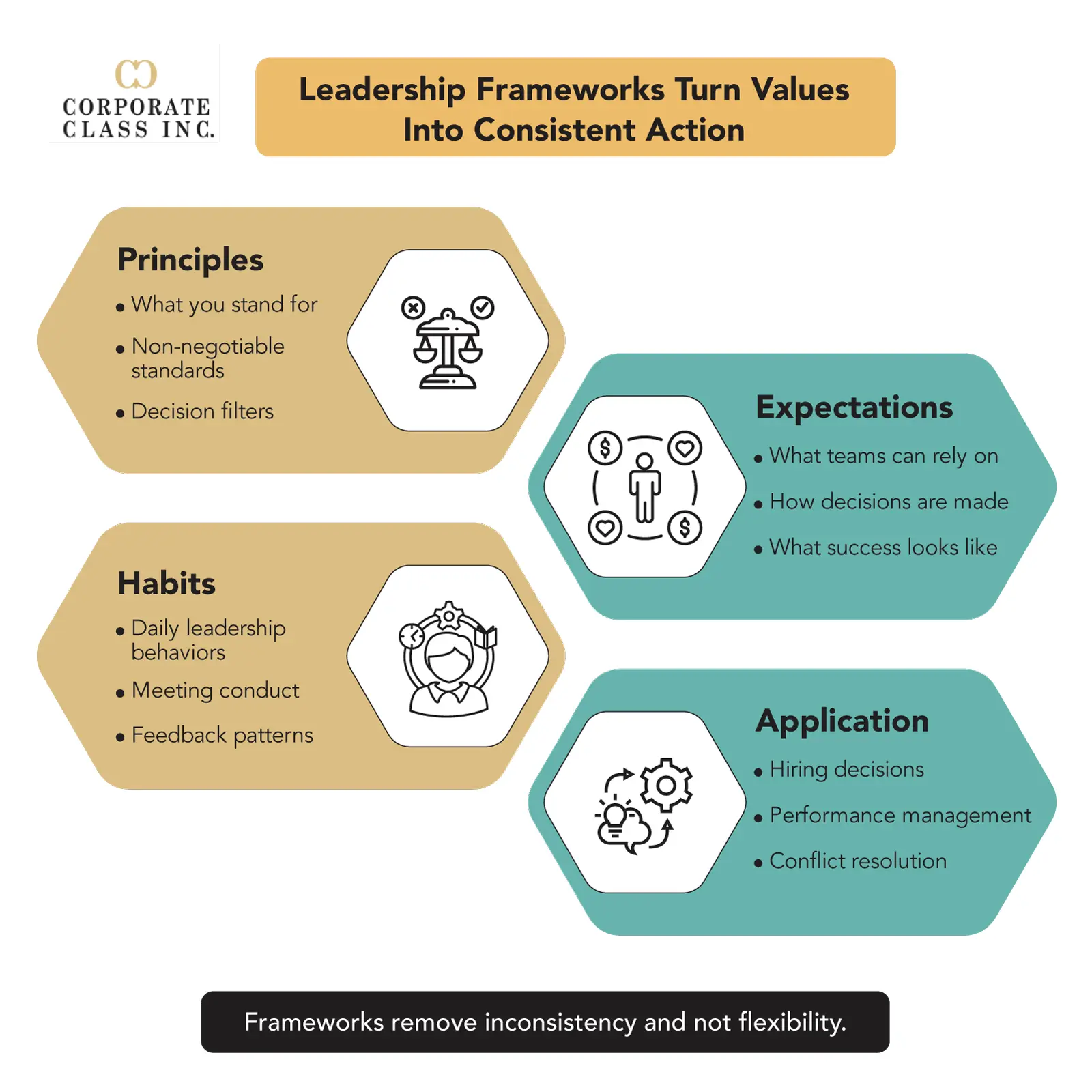
Leadership principles form the backbone of your leadership framework. They act as decision filters that guide behaviour when pressure rises and clarity drops. Strong principles remove ambiguity. They tell your team what you value through action rather than slogans.
Many leaders confuse values statements with leadership principles. Values often describe aspirations. Principles define behaviour. A value may state integrity. A principle explains how integrity shows up during deadlines, conflict, feedback, and performance reviews.
Your leadership framework should include a small number of principles you can recall without effort. Five to seven principles work well. Each principle should meet three criteria. It must guide decisions. It must influence behaviour. It must be observable by others.
Examples of leadership principles expressed clearly:
- Decisions are explained, not announced
- Accountability is direct and timely
- Feedback is specific and actionable
- Standards apply equally across roles
- Preparation signals respect
These principles shape how you lead meetings, handle mistakes, manage performance, and represent the organization externally. They also reduce emotional decision-making. When pressure hits, your principles act as guardrails.
To define your principles, review moments where leadership felt strongest. Identify what behaviour created trust, clarity, or momentum. Then examine moments where leadership faltered. Look for missing standards rather than personality flaws.
Write each principle as a behavioural statement. Avoid abstract language. If a team member observed your leadership for a week, they should be able to describe your principles accurately.
A leadership framework without behavioural principles becomes decorative. One grounded in daily practice becomes operational.
Setting Clear Expectations Aligned with Your Leadership Vision
Expectations translate leadership principles into shared standards. They clarify how work gets done, how decisions are made, and how accountability functions. Clear expectations remove friction. They also prevent conflict from becoming personal.
Your leadership vision describes the environment you want to create. Expectations explain how people operate inside that environment. Without alignment between vision and expectations, teams experience confusion.
Start by defining expectations across four areas:
- Decision ownership
- Communication standards
- Performance accountability
- Professional conduct
Decision ownership clarifies who decides, who contributes, and who executes. Ambiguity here slows execution and creates tension. Your leadership framework should specify when consensus is required and when speed matters more.
Communication standards define response times, meeting preparation, escalation paths, and feedback norms. These standards prevent assumptions. They also protect focus.
Performance accountability explains how goals are set, tracked, reviewed, and adjusted. Teams perform better when expectations remain visible and consistent.
Professional conduct sets boundaries around respect, behaviour, and responsibility. This protects culture during stress.
Expectations must be documented, reinforced, and modeled. Stated expectations without leadership behaviour behind them lose credibility fast.
Share expectations early. Repeat them often. Reference them during decisions. When expectations guide action, leadership feels predictable in the best way.
A leadership framework gains power when expectations align tightly with leadership principles. That alignment creates trust.
Developing Habits That Reinforce Leadership Credibility
Leadership credibility grows through repeated behaviour. Habits shape that behaviour. Without habits, leadership relies on motivation. Motivation fluctuates. Habits persist.
Your leadership framework should include a small set of habits that reinforce your principles. These habits operate daily and weekly. They require minimal effort yet deliver compounding impact.
Effective leadership habits include:
- Weekly review of priorities before meetings
- Written follow-ups after key decisions
- Scheduled feedback conversations
- Preparation time before high-stakes discussions
- Consistent reflection after major outcomes
These habits send signals. Preparation signals seriousness. Follow-up signals accountability. Reflection signals growth.
Many leaders underestimate how closely teams watch behaviour. Small inconsistencies erode credibility faster than visible mistakes. Habits create consistency.
Design habits that fit your role and environment. Avoid overloading your calendar. Choose habits that support your leadership framework without creating friction.
Track habits for thirty days. Observe changes in team engagement, decision speed, and communication quality. Adjust where needed.
Leadership credibility does not come from charisma. It comes from reliable behaviour over time. Habits make that reliability visible.
Using Your Framework to Guide Team Development
A leadership framework becomes truly valuable when it shapes how you develop others. It provides a shared language for growth. It also removes subjectivity from development conversations.
Use your framework as a reference during onboarding, performance reviews, and coaching discussions. Explain how leadership principles connect to team expectations. Show how habits reinforce results.
When developing team members, map behaviours to framework elements. Instead of vague feedback, anchor guidance in agreed standards.
Examples:
- Communication needs clarity during decision updates
- Ownership requires follow-through without reminders
- Preparation improves meeting outcomes
This approach keeps feedback focused on behaviour rather than personality. It reduces defensiveness. It increases uptake.
Encourage team members to build their own leadership framework aligned with yours. This creates coherence across levels. It also supports succession planning.
High-performing teams share leadership standards even across different styles. A leadership framework creates that alignment.
Adapting Your Leadership Framework to Changing Environments
Leadership frameworks require evolution. Static frameworks lose relevance as organizations grow, markets shift, and roles expand. Adaptation protects usefulness.
Review your leadership framework during transitions. New responsibilities introduce new pressures. External changes reshape expectations. Internal growth demands recalibration.
Ask targeted questions:
- Which principles still guide decisions effectively
- Which habits support current demands
- Where expectations require adjustment
Avoid rewriting the framework entirely. Preserve core principles. Adjust application.
In remote environments, communication standards require clarity. In growth phases, decision ownership may decentralize. During uncertainty, transparency standards rise.
Adaptation shows maturity. It signals awareness rather than inconsistency.
Communicate updates clearly. Explain why adjustments matter. Model changes immediately.
A leadership framework that adapts remains credible. One that stays rigid becomes symbolic.
Measuring Success Through Your Leadership Framework
Measurement converts leadership effort into observable outcomes. Without measurement, leadership remains subjective.
Define success indicators aligned with your framework:
- Decision speed
- Quality of execution
- Team engagement scores
- Feedback frequency
- Leadership bench strength
Track behavioural indicators alongside results. Observe meeting effectiveness. Monitor follow-through. Review communication clarity.
Use feedback loops. Ask teams how leadership standards show up in practice. Listen without defensiveness.
Measurement reinforces accountability. It also provides evidence of leadership impact.
FAQ
What makes a leadership framework effective?
An effective leadership framework focuses on behaviour rather than personality. It provides clear principles, expectations, and habits that guide decisions consistently. Teams understand what leadership looks like in practice. Consistency builds trust over time.
How often should a leadership framework be updated?
Review your leadership framework during major role changes, organizational shifts, or performance plateaus. Minor adjustments may occur annually. Core principles typically remain stable. Application evolves with context.
Can leadership frameworks work across different leadership styles?
Leadership frameworks support different styles by defining standards rather than personality traits. Leaders retain individuality while aligning behaviour. This balance strengthens culture. It also improves collaboration across teams.
Building Leadership That Lasts
A leadership framework creates structure where leadership often relies on instinct. It clarifies how you lead when conditions change and pressure increases. It aligns behaviour, expectations, and development into a single operating system. Over time, this consistency compounds into credibility, trust, and measurable results. Leaders who invest in a leadership framework lead with clarity today and stability tomorrow.